
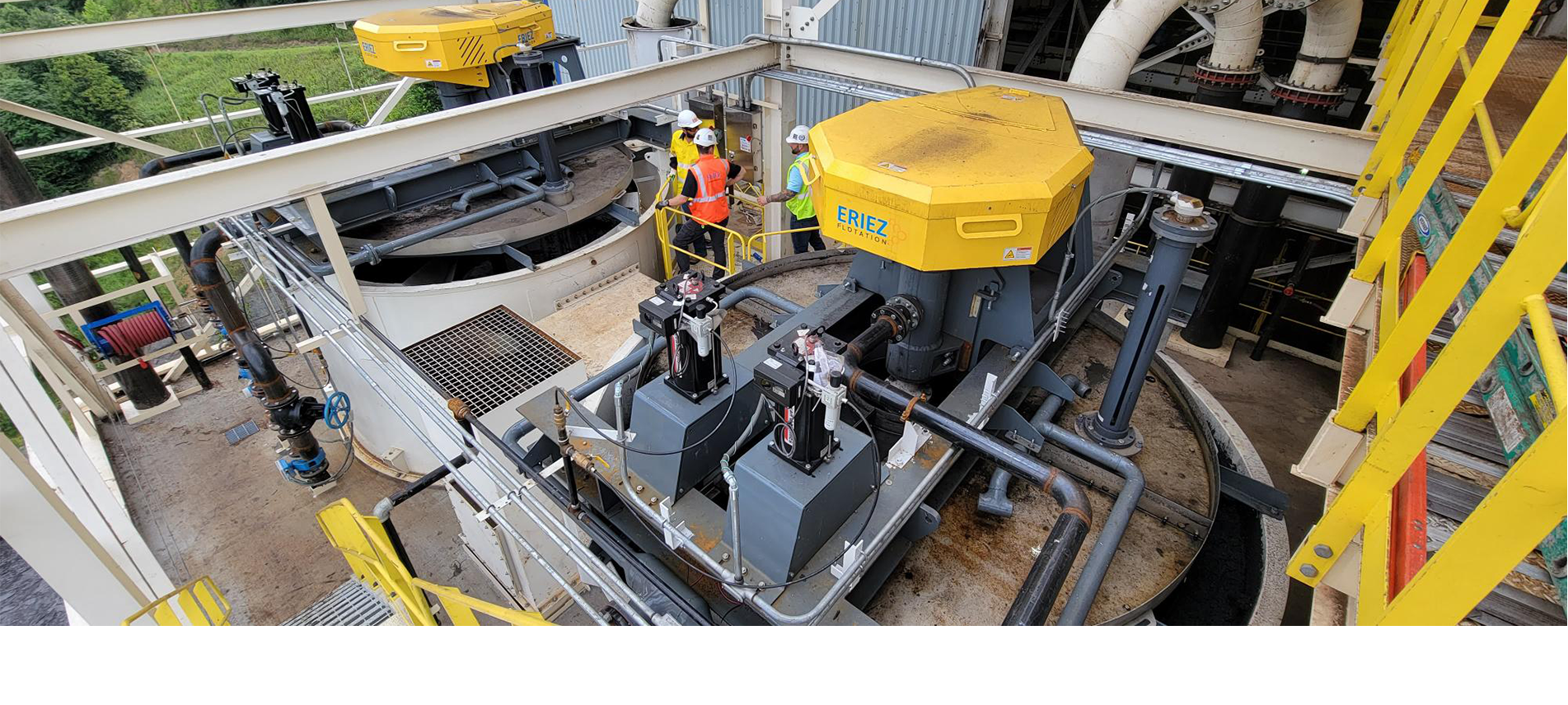
StackCell Mechanical Flotation
Superior Metallurgical Performance
StackCell® flotation reduces the conventional flotation residence time requirement by 75% to 85% and increases the selective recovery of fine particles and slow-floating minerals, which increases profitability and improves the environmental sustainability of mining projects. For mining companies that want to reduce the environmental impacts of flotation circuits for maximum profitability, the StackCell offers reduced flotation circuit size and power consumption while delivering superior mineral recovery and concentrate grades.
Engineered for Ultrafine Recovery
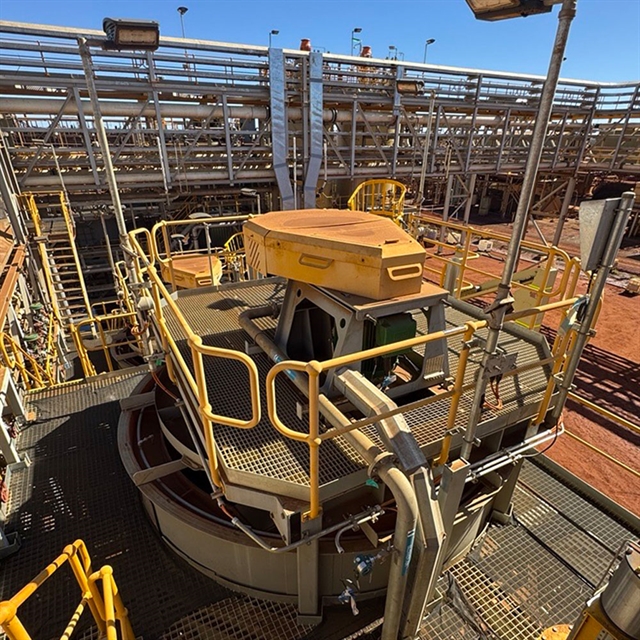
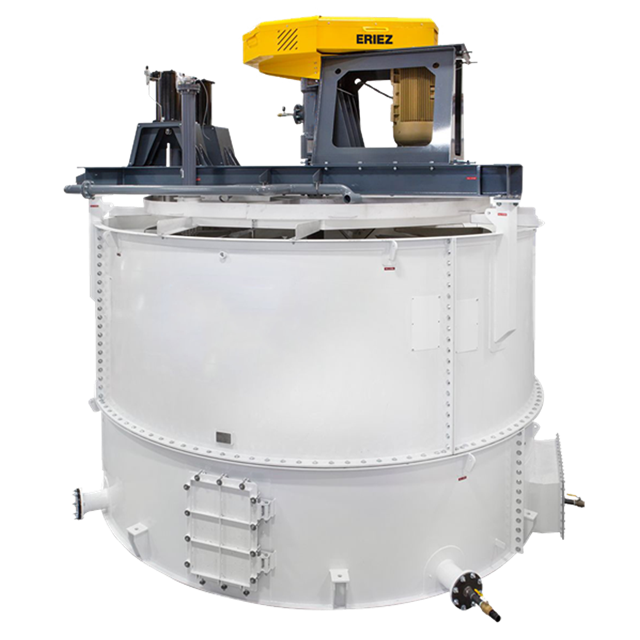
StackCell delivers a step-change in flotation technology, unlocking fine and ultrafine particle recovery with a fraction of the energy, volume, and footprint. By decoupling the particle collection and phase separation zones, StackCell provides optimal flotation kinetics for minimal turbulence and entrainment in the separation chamber.
Features
- Lower installation and operating costs
- Measurable reductions in energy use and environmental impact
- High recovery of fine particles
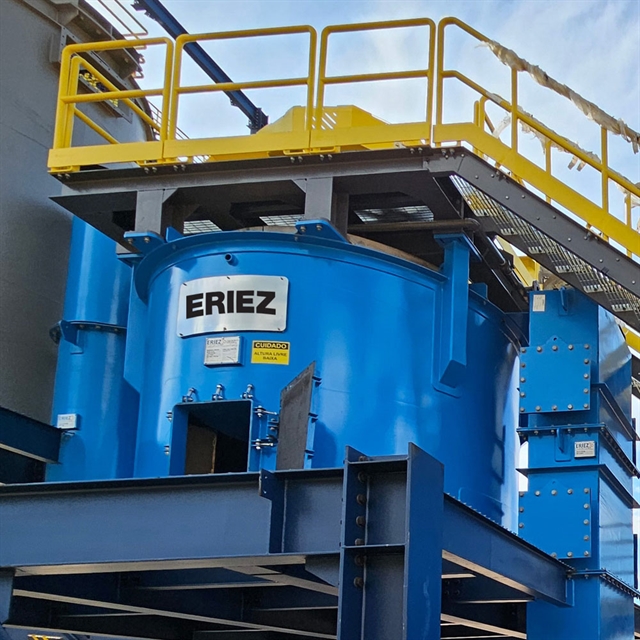
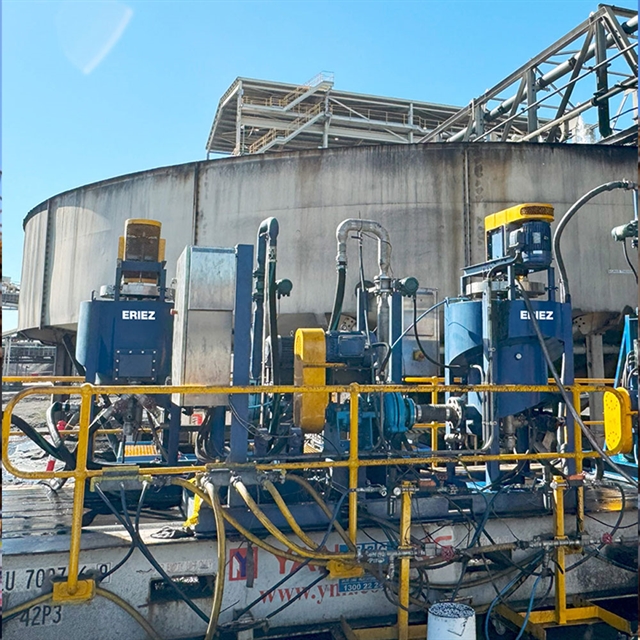
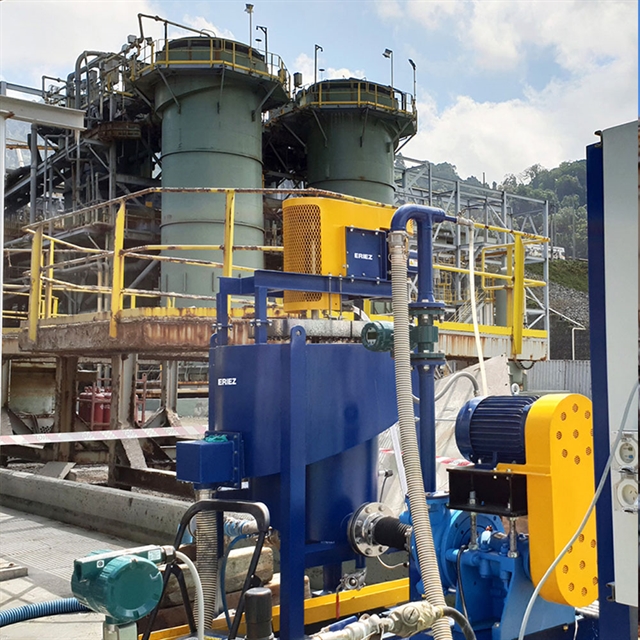
Designed for ESG Performance
StackCell redefines flotation by concentrating energy at high intensity exactly where it is required—for effective bubble-particle collision and attachment. This focused energy dissipation, up to five times higher than in conventional flotation cells, creates the ideal hydrodynamic environment for recovering ultra fine, fine and mid-size particles. The result is superior metallurgical performance tailored to the demands of modern concentrators. At the same time, StackCell supports ESG objectives through reduced energy consumption, lower reagent usage, and a compact, sustainable design.



Innovative Features
Efficient & Robust Design
The StackCell mechanical flotation technology builds on the concept of focused energy input to enhance fine particle recovery and improve flotation kinetics over the full range of particle sizes. Through multiple full-scale installations and pilot-scale trials in base metals, the StackCell has been proven to reduce flotation residence time requirement by 75–85% and increase fine particle recovery compared to conventional flotation cells.
High-Turbulence Chamber
The key feature of the StackCell is a high-turbulence contacting chamber that is isolated from a quiescent separation chamber, which allows for independent optimisation of the particle collection process and the froth recovery process.
In the StackCell, pulp and air are introduced to the bottom of the contacting chamber through the feed inlet and air inlet. The pulp and air are subjected to intense mixing while traveling up through the contacting chamber and the mixture is discharged into a quiescent separation and recovery chamber to allow for a phase separation to occur between the pulp and froth. The froth depth is maintained sufficiently deep to facilitate the use of counter-current wash water, thus minimizing the entrainment of fine hydrophilic particles.
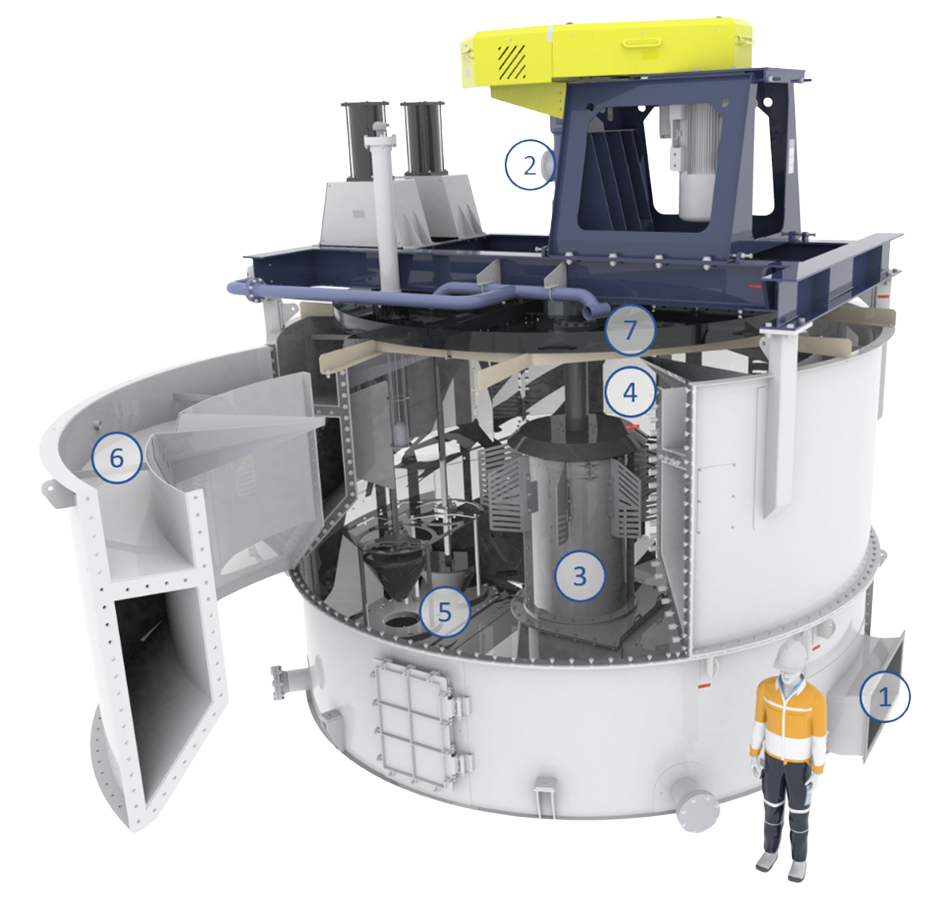
1) Feed slurry inlet 2) Air inlet 3) Contacting chamber 4) Separation chamber 5) Tailings discharge 6) Froth discharge 7) Wash water system
Stacked Benefits
- Enhanced Recovery: Accelerating Flotation kinetics of coarse and fine particles in the rougher-scavenger circuit at minimal residence time.
- Reduced Footprint: Minimize environmental impact through lower power consumption utilizing cells that are as low as 20% the size of conventional ones. Reduce foundation load by 70% and installation footprint by 50% against the conventional mechanical cell.
- Higher-grade Concentrates: Be able to use wash water in the separation vessel, generating a final concentrate grade in rougher scalper and cleaner scalper applications.
- Reduced CAPEX & OPEX: Drive down capital expenditures by saving space, and lower operating costs.
- Increase Project NPV: Raise Net Present Value by making the flotation process both streamlined and more efficient.
Technology Advancement
- Efficient Separation: The StackCell's two-stage flotation cell design separates the particle collection chamber from the phase separation chamber, focusing energy on maximizing bubble-particle collisions while reducing energy use during phase separation.
- High Performance: The turbulent dissipation rate in the particle collection chamber reaches up to 120 W/kg — five times higher than that of conventional mechanical cells, which is highly beneficial for improving the recovery of fine particles.
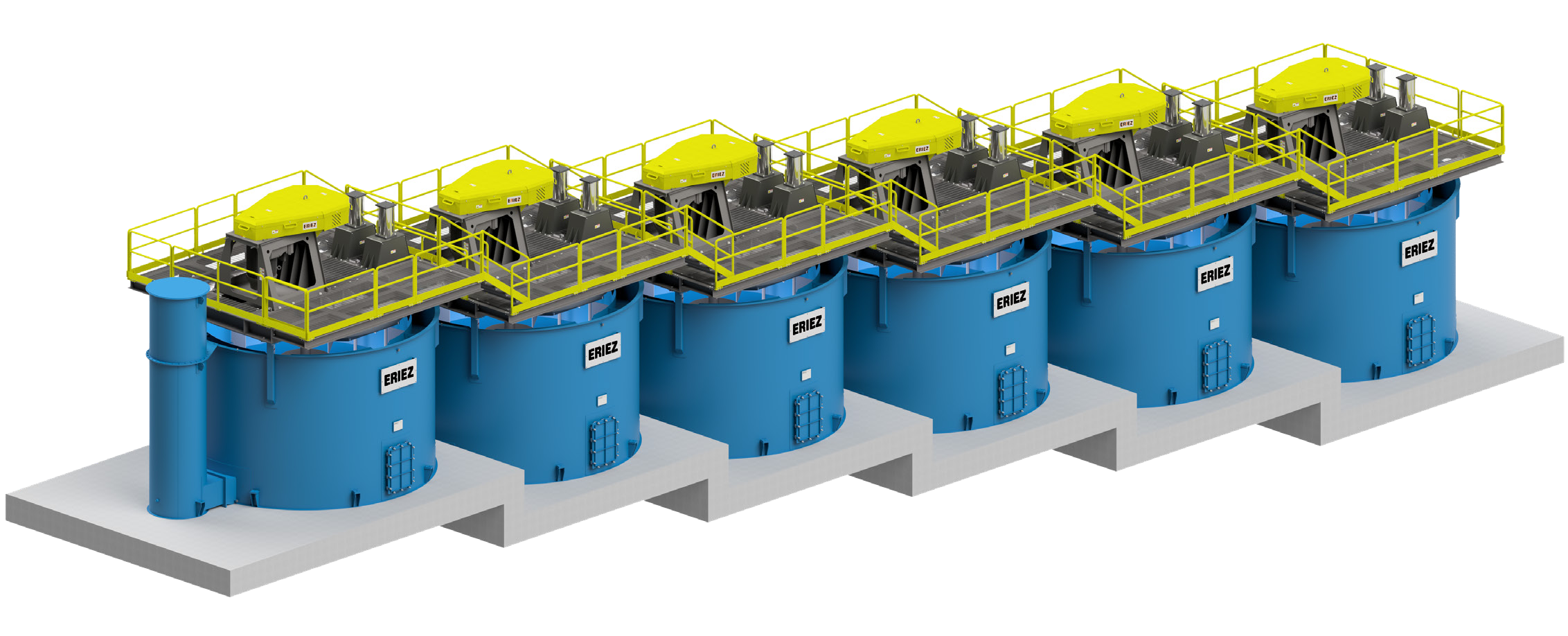
- Compact Design: Modular units integrate seamlessly into existing flotation circuits, delivering flexibility and scalability with up to four times less volume than conventional cells.
- Sustainable Solution: Responsible mining through efficient resource utilisation, reduced operational costs, and a flexible, adaptable flowsheet enabled by cell-in-series configurations.
Innovative Hydrodynamic Engineering
The StackCell achieves a 75% to 85% reduction in flotation residence time requirement by increasing the flotation rate constant of minerals through introduction of air and particles directly into the multi-stage rotor-stator mechanism within the contacting chamber.
Multi-Stage Design
The StackCell multi-stage rotor/stator mechanism generates strong shear layers in the wake region of slots near the suction side of the rotor blades. Large vortices in the shear layers interact and product micro-vortices similar in size to fine mineral particles. Micro-vortices increase the inertia of fine particles, which enables high collision rates and squeezing of liquid film between particles and air bubbles.
StackCell turbulent dissipation rates reach values up to 120 W/kg, which is nearly 5 times greater than the turbulence dissipation rate in the rotor/stator region of conventional flotation machines.
This improvement in turbulent dissipation rate in the StackCell contact chamber explains why the flotation rate constant in the StackCell is roughly 4 to 5 times higher than conventional flotation machines.
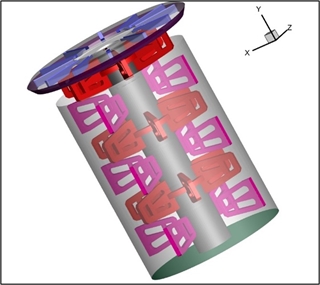
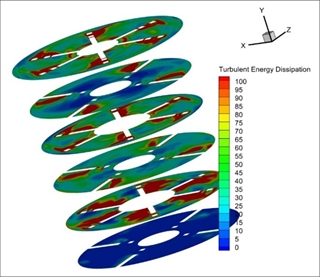
StackCell Turbulent Dissipation Rate
Greater Value
Increase Project Net Present Value
- Lower TIC with reduced flotation plant footprint reduces payback period and improves project IRR/NPV.
Improved Recovery of Fine Particles
- Higher recovery of fine particles generates increased revenues at equivalent processing rate.
Increase Concentrate Grade
- Increase flotation selectivity by rejecting entrained fine particles from concentrate froth.
Increase Mill Production and Gross Revenue
- Expand brownfield throughput or increase recovery at present throughput within existing plant footprint with cells that are 20% of the size of conventional cells. Recover additional fines to concentrate that would otherwise be discarded to tailings.
Maximum Efficiency
Increase Production Capacity within Existing Plant Footprint
-
Maximize use of existing plant footprint by adding 4-5 times recovery improvement in available space compared to conventional stirred-tank cells.
Reduce Carbon Footprint and Environmental Impact
- Reduced carbon footprint via reduced power consumption and smaller plant size with less concrete and steel requirements.
Increase Mine Life at Equivalent Production Level
- Reduced fine tailings disposal from improved fines recovery.
Reduce CAPEX for Greenfield Projects and Brownfield Expansions
- Benchmarking against conventional stirred-tank flotation cells shows reduction in foundation loads of 70% and reduction of installation footprint and envelope of 50%.
Models
Various standard cell sizes available to fit a wide range of mineral applications and duties. StackCell naming convention identifies the equivalent conventional flotation capacity delivered by each StackCell unit. For example, a model SC-200 provides at minimum the equivalent flotation capacity as a 200 m3 conventional flotation cell.
| Model | Installed Power (kW) | Air Rate Per Cell (Am3/hr) | Air Pressure At Shaft Inlet (kPag) |
|---|---|---|---|
| SC-20 | 15 | 80 | 34.5 |
| SC-50 | 55 | 600 | 34.5 |
| SC-70 | 55 | 1400 | 34.5 |
| SC-100 | 110 | 1400 | 34.5 |
| SC-200 | 110 | 1500 | 34.5 |
CEEC Spotlight Leader Conversations: Eric Wasmund
Eriez StackCell Animation Technology Walkthrough
Eriez StackCell SC-200 Assembly Time Lapse
 Brochures & Technical Papers

Eriez StackCell - Delivering Superior Fine and Mid-Size Particle Recovery - StackCell delivers a step-change in flotation technology, unlocking fine and ultrafine particle recovery with a fraction of the energy, volume, and footprint. By decoupling the particle collection and phase separation zones, StackCell optimises flotation kinetics while minimising turbulence and entrainment in the separation chamber.
StackCell: A New Flotation Technology for Decreasing Cost and Increasing Performance - Froth flotation is the most industrially significant process for upgrading a wide range of mineral systems. Most operating concentrators have a flotation line. The majority of these operations use mechanical tank cells for the lion’s share of the flotation requirements.
Benchmarking Performance of the Two-Stage StackCell with Conventional Flotation for Copper Sulfide Applications - Rougher flotation in sulfide ore applications is typically performed using conventional flotation machines. The trend over the last 100 years has been for these cells to become larger in volume with cells reaching sizes of 600 m3 and in some cases even larger.
Improving Fine Particle Flotation Using the StackCell (Raising the Tail of the Elephant Curve) - For decades, the conventional flotation machine has been the accepted tool for processing sulfide ores. As plant capacity increases, machine size has evolved to as much as 600 cubic meters to keep pace with the required retention times. However, the excessively large size of these machines requires extreme floor space, foundations and power to operate. Recent work conducted by Eriez has shown that high-efficiency flotation machines which are based on focused energy input can achieve similar results with significantly less retention time, floor space and power.
The Application of High Intensity Flotation Technology at Mt Keith Nickel Concentrator - Conventional flotation technology has historically failed to achieve high recoveries when treating <15 μm particles. The new StackCell flotation technology was developed to specifically target this particle size range, and was tested at pilot plant scale at Mt Keith Nickel Concentrator.
A high rate mechanical flotation cell for base metal applications - Mechanical cells are the dominant unit operation in base metal rougher flotation applications worldwide. As economic demand for metals increase, and as the feasible ore grades decrease, the installed capacity of mechanical flotation units worldwide has greatly increased, adding significant capital and operating cost. One opportunity to improve this situation is to use fundamental knowledge to make the industrial flotation process more efficient.